Why Ill Never Work in an Ofice Again
Why a broad-calibration render to the function is a myth
(Image credit:
Getty Images
)

For 2 years, employees accept been waiting for 'the solar day' when anybody goes back to the office. But it's probably never coming.
W
Workers were meant to have returned to the office by at present. Our expectation, back in early 2020, was that once the pandemic had ended, we'd all collectively resume our pre-Covid patterns of function-based working.
Yet that'due south not how things take turned out. Two years on, employees around the earth continue to face ongoing dubiety as to when – and if – they'll be expected back at the workplace in person. The emergence of different Covid-19 variants has exacerbated matters; Omicron has triggered record cases globally, forcing employees who were slowly adapting to a partial, hybrid return to the office to reverse class and work remotely again.
Today, the idea that we'll all return to the office together once again seems highly unrealistic. Some companies have already switched permanently to remote work or hybrid models. And, while others may exist holding out for staff to come back to their desks, each delay further entrenches flexible working patterns – rendering a full-staff return less probable.
"The return-to-office date has died," says Nicholas Bloom, professor of economics at Stanford University, U.s.. "Countless waves of Covid have led nearly CEOs to give upwardly, and instead set upward contingent policies: if, when and how to render to the part."
But if nosotros finally abandon the thought that there will ever be a day when we're all permanently dorsum at our part desks, what should nosotros expect instead?
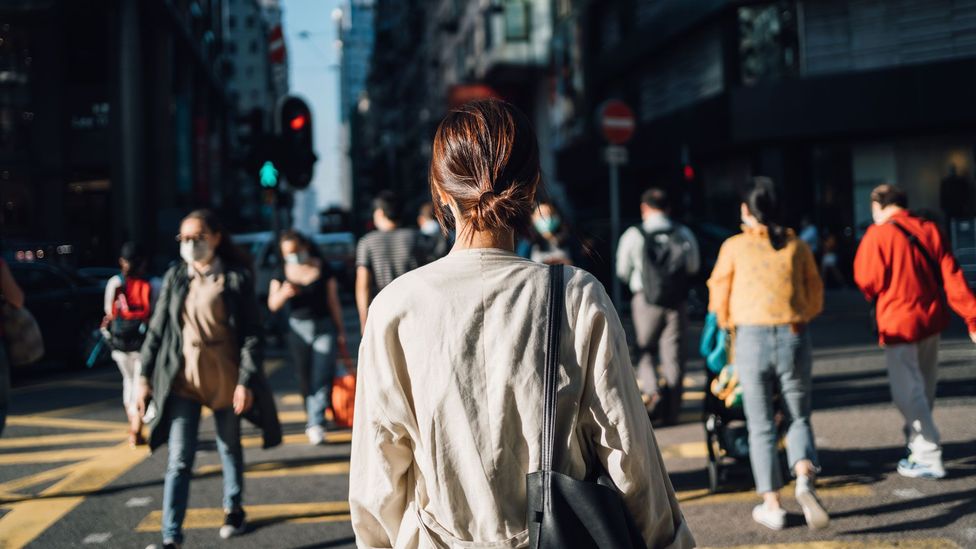
The days of workers jamming streets to get to work en masse may get a relic of pre-pandemic days (Credit: Getty Images)
Why in that location's no 'back to normal'
When the pandemic outset hit, and its scale was yet to be mapped, a widespread return to the workplace seemed probable in 2020.
Employers and employees alike anticipated a hard engagement to come back: some kind of reversion to a pre-pandemic normal – the majority of workforces together in offices, at least a few days a week. In turn, the expectation was that many prior characteristics of work, such as the fixed nine-to-5 schedule, would be restored.
Businesses of all kinds, across multiple sectors, set return-to-role dates throughout 2020. However, as the pandemic dragged on, companies pushed plans back. This was in function due to ongoing wellness concerns in many countries, but besides because workers had go comfortable – and remained productive – in their remote set-ups, and some fifty-fifty pushed dorsum confronting these dates.
"Early in the crisis CEOs would pronounce render-to-office plans just for them to get wiped out past each new wave and variant," explains Flower. And even when employers did fully expect to bring workers back at a defined moment regardless, the unpredictable nature of the pandemic meant render-to-office dates were increasingly kicked down the road.
At present, in the 3rd year of Covid-19, the return-to-office engagement remains a constantly moving target. It seems increasingly improbable to expect a universal return. Flexibility and remote work take become then securely rooted that reimposing pre-pandemic working models appears a nigh-on impossible job. "Habits are hard to break," says Almuth McDowall, professor of organisational psychology at London'south Birkbeck Academy. "We've all harnessed more innovative, efficient means of doing our jobs."
Dubiety around health remains rampant; nosotros don't know when the pandemic will stop, whether Covid will become endemic or if another variant will sally – let alone rough dates for when these might occur. And employees will keep to take different levels of run a risk tolerance; for instance, a healthy, single person may be more willing to go back to the office than an immunocompromised worker, or one with children likewise young to be vaccinated. "Amid Omicron, in that location is much low-level anxiety – many don't want to rush back to the office," adds McDowall.
Because all these factors, setting a sweeping, all-employee return-to-part date the manner companies have been attempting – and workers have been anticipating – since 2020 seems like a fantasy: a construction of the past that no longer reflects our irresolute world.
Devil in the details
Ultimately, the office return volition look unlike beyond sectors and companies; there won't be a ane-size-fits-all 'back to work' date – and for some employees, there won't be a date at all. How does a worker figure out what's next for them?
The means – and reasons why – employers have already planned to bring dorsum their workers during the pandemic may be a proficient indicator for how they'll try to do and then in the future.
On one paw, it's likely many of the sectors who've tried mightily to pull employees back into the office multiple times during the pandemic will be keen to create the fastest, most sweeping return-to-function policies.
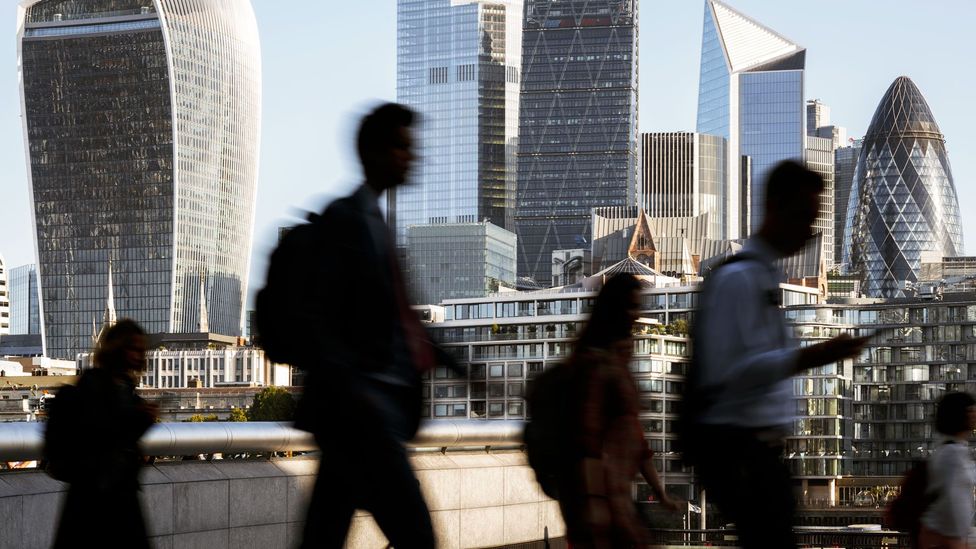
Some industries, like finance, are more than likely to return to the office as quickly as possible – but their plans are even so upwards in the air (Credit: Getty Images)
For case, in finance, executives have been aggressive in their timelines to bring people back. This is in role due to a highly in-person work civilization, but likewise due to "aspects of financial services, particularly around the trading floor, which aren't equally piece of cake to practice remotely", says Chris Leahy, founder of due-diligence investigative firm Blackpeak. Essentially, businesses like these are less nimble than others, frequently hamstrung by regulations and decades-old practises still assuming that, at some point, anybody will return.
Even in other sectors that aren't so regulation-jump, many businesses accept repeatedly set hard render dates, though they've had to motility them, sometimes multiple times. Although it's still murky as to when, workers at companies like these should program to return to the office at some bespeak, since information technology's clear their employers are still placing emphasis on at least some in-person work.
Even so, despite these indicators, the futurity may be even more malleable than nosotros wait. Even as some sectors cling to pre-pandemic ways of working, worker power may potentially destabilise some employers' best laid plans.
For example, Bloom says employees' desire to work from dwelling house has strengthened as the pandemic has lingered, meaning many return-to-office plans have received staff backlash, both in the finance and tech industries, particularly from younger workers who question the wisdom of returning to the office at all. Bloom adds that the ongoing hiring crisis also means that workers in some sectors currently have more power than before; if their employer won't accommodate requests for different job conditions such as flexible working, employees can choose to switch to ane who volition.
Simply, the devil will be in the details for every individual visitor and role: what the 'return-to-the-office' volition look like in practice volition differ from worker to worker – a procedure that'southward still taking time. "Many bosses haven't been able to brand a firm decision even so, because we don't know exactly what will happen," says McDowall. "If you don't retrieve it'southward the correct thing for your business to become fully remote or hybrid, then information technology makes sense to delay for every bit long every bit possible."
No matter when leaders can start making those decisions, notwithstanding, it seems all but certain that the day when we're all dorsum together on the train platform, heading into our offices for a Big Bang restart, is gone. Although it may non exist confirmed all the same by bosses, the formal end to the full office return is coming – if not yet already hither. "Unless something drastically changes, then the total return to the office is probable a myth," says McDowall.
Source: https://www.bbc.com/worklife/article/20220113-why-a-wide-scale-return-to-the-office-is-a-myth
0 Response to "Why Ill Never Work in an Ofice Again"
Post a Comment