what refers to a structure nearest to a major point of reference
Human anatomy is the written report of the structure of the human body. Anatomical terms allow health care professionals to accurately communicate to others which part of the torso may be affected by disorder or a disease
Terms are defined in reference to a theoretical person who is continuing in what is called anatomical position (see effigy below): both feet pointing frontwards, arms down to the side with palms forward (thumbs pointed away from the body). The positions of the arms and legs have important implications for directional terms.
In the anatomical position, the head is upright and facing frontwards. In men, the penis is considered to exist erect in the anatomical position e.g. the dorsal surface of the penis is actually the anterior (forepart-facing) surface in the flaccid state.
Ultimately communicating using anatomical terms makes it easy to communicate description of body areas regardless of the individual's position. For example, suppose a doctor was trying to depict an area of the trunk to another physician on a patient who is lying face up down? Descriptions would be based on anatomical position to brand things simpler and to avoid whatever confusion.
Directional Terms
For the almost role, directional terms are grouped in pairs of opposites based on the standard anatomical position.
- Superior and Inferior – Superior means above, inferior means below. E.g. The elbow is superior (higher up) to the hand. The foot is inferior (below) to the genu.
- Anterior and Posterior – Inductive means toward the front (chest side) of the torso, posterior ways toward the back.
- Medial and Lateral – Medial means toward the midline of the body, lateral ways away from the midline.
- Proximal and Distal – Proximal ways closest to the betoken of origin or trunk of the body, distal ways farthest abroad. These terms are often used to draw the arms and legs. If you were describing the shin bone, the proximal stop would be the end closest to the articulatio genus and the distal end would exist the end closest to the human foot. In the fingers, a proximal joint is the ane closest to the wrist and a distal joint is the one farthest from the wrist.
- Superficial and Deep. Superficial ways toward the body surface, deep ways away from the body surface. E.1000. Skin is superficial to a person's organs. A person's organs are deep to skin.
- Cephalad (or rostral) and Caudal. Cephalad means towards the head and caudal ways towards the tail bone.
- Dorsal and ventral – dorsal refers to the back and ventral to the front. In the human body, these terms are interchangeable with posterior and anterior. However, when describing structures within the skull, a dorsal structure is closer to the meridian of the skull, and a ventral structure is closer to the base of the skull.
Other Directional Terms:
- Ipsilateral means on the aforementioned side— e.g. left arm is ipsilateral (on the aforementioned side) to the left leg.
- Intermediate – in between—your heart is intermediate to your lungs.
- Visceral – may be used instead of deep – typically used in reference to organs
- Palmar references the palm side of the paw.
- Plantar references the bottom of the human foot.
Anatomical Reference Planes
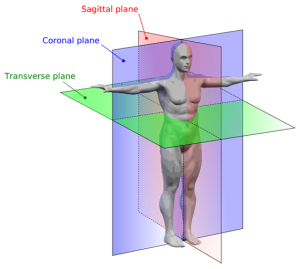
A plane is a theoretical line that divides the body. These planes are frequently used to draw location of structures or to describe directionality of motility. Oftentimes, these terms are used within the context of advanced medical imaging studies such as computed tomography (CT) and magnetic resonance imaging (MRI) scans.
Main Reference Planes
- Sagittal (also known as longitudinal) plane — this vertical (pinnacle to bottom) aeroplane divides the body into left and right sides. The theoretical aeroplane that divides the body down the eye into equal left and right sides is known as the median sagittal plane.
- Coronal (also known as frontal) plane — a vertical airplane that divides the trunk into front and dorsum halves
- Transverse (also known equally centric or horizontal) airplane — this horizontal plane is parallel to the ground and divides the body into upper and lower halves.
- Oblique plane (not shown in the figure) is a slanted aeroplane (at an angle) that lies between the horizontal and vertical planes.
You lot can run across that the 3 basic planes (sagittal, coronal, transverse) intersect one another at right angles. For "normal" human bodies, the right and left sides are mirror images if divided right down the center by the sagittal plane as shown in the prototype below.
Motion near these planes tin be described by an axis of movement. For example, movement about the sagittal axis occurs in the sagittal airplane e.chiliad. bending forwards and backwards. Appropriately, movement about the transverse axis occurs in the transverse aeroplane due east.one thousand. twisting at the waist. Finally, movement nigh the coronal axis occurs in the coronal plane east.g. angle your trunk to the left or right.
Body Cavities
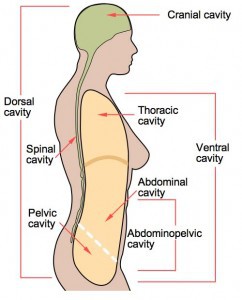
Torso cavities are areas in the body that contain our vital organs. The dorsal and ventral cavities are the two main cavities. The dorsal crenel is on the posterior (back side) of the body and contains the cranial and spinal cavities. The ventral cavity is on the front (inductive) of the body and is divided into the thoracic (chest) and abdominopelvic cavities.
Dorsal Crenel
The dorsal cavity is farther divided into the following subcavities:
- The cranial cavity contains the brain
- The spinal (or vertebral cavity) contains the spinal cord.
Ventral Cavity
The ventral cavity is on the forepart of the trunk. The diaphragm (the primary musculus of breathing) divides the ventral crenel into two simple subcavities: thoracic and abdominopelvic cavities.
- Thoracic cavity is superior (above) to the diaphragm and abdominopelvic cavity. It is lined by the ribs and chest wall. It is farther divided into the pleural cavities (left and right) which contain the lungs, bronchi, and the mediastinum. The mediastinum contains the heart, large vessels of the heart, trachea (windpipe), upper esophagus, thymus gland, and lymph nodes.
- Abdominopelvic cavity is farther divided into the abdominal and pelvic cavities.
- The abdominal cavity is between the diaphragm and the pelvis. Information technology contains many of the gastrointestinal organs such every bit the tummy, intestines (except the sigmoid colon and rectum), spleen, liver, gallbladder, pancreas, adrenal glands, kidneys and ureters.
- The pelvic crenel contains the bladder, some of the reproductive organs and the rectum.
The Thoracic and Abdominopelvic Cavities
The thoracic cavity is open at the top and the abdominopelvic cavity is open up at the bottom. Both cavities are bound on the back by the spine. Even though their locations are defined, the shape of these cavities can alter. Breathing is the chief fashion that the shape of these two cavities can modify.
The abdominopelvic crenel changes shape similar to a h2o-filled airship. When you squeeze the balloon, the balloon asymmetrically bulges. Similarly, when breathing compresses the abdominal cavity, it "bulges" into a unlike shape. The abdominal cavity can also change shape based on its independent volume—i.east. depending on how much you eat and drink. The more you consume and drink, the harder information technology is for the diaphragm to compress the abdominal crenel—which is why information technology is harder to breathe after a big meal. Too, an increment in volume of the abdominal cavity decreases the volume in the thoracic cavity—you lot can take in less air.
The thoracic crenel changes shape and volume when y'all breathe. When you exhale out, its volume decreases; when you exhale in, its book increases.
Other Cavities
- Rima oris – the infinite in the mouth within the teeth and gums and is filled with the tongue when information technology is relaxed.
- Nasal cavity – in the nose
- Orbital cavities (left and right) – hold the eyes
- Middle ear cavities (left and right) – hold the pocket-size bones of the centre ear
- Synovial cavities – are inside the articulation capsules that surroundings freely moving joints (such every bit the hip, knee joint, elbow, and shoulder)
Torso Quadrants
Quadrants are another style our bodies are divided into regions for both diagnostic and descriptive purposes.
Abdominal Quadrants
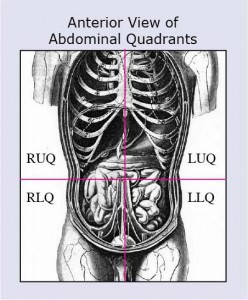
Quadrants split our bodies into regions for diagnostic and descriptive purposes. The quadrants are defined past drawing an imaginary line vertically (top to bottom) and horizontally (sideways) though the umbilicus (abdomen button). The following is a list of the organs in the iv quadrants.
- Right Upper Quadrant (RUQ) – right lobe of liver, gallbladder, role of the transverse colon, role of pylorus, hepatic flexure, correct kidney, and duodenum.
- Right Lower Quadrant (RLQ) – cecum, ascending colon, modest intestine, appendix, bladder if distended, right ureter, right spermatic duct (men), correct ovary and right tube and uterus if enlarged (women).
- Left Upper Quadrant (LUQ) – Left lobe of liver, stomach, small-scale intestine, transverse colon, splenic flexure, pancreas, left kidney and spleen.
- Left Lower Quadrant (LLQ) – minor intestine, left ureter, sigmoid flexure, descending colon, float if distended, left spermatic duct (men) left ovary and left tube and uterus if enlarged (women).
Body Regions
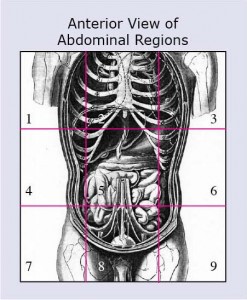
Body regions are further subdivisions of the body quadrants. They are named based off of the special function that the organs within that region perform or based on the blood or nervus supply to that region. The nigh widely used regional terms used are those that depict the 9 abdominal regions shown in the image to the right. The regions are named below and the corresponding regions are labeled 1-ix.
Abdominal Regions
- Right (1) and left (3) hypochondriac regions – on either side of the epigastric region. Contains the diaphragm, some of the kidneys, right side of the liver, the spleen and part of the pancreas.
- Epigastric region (2) – superior (above) the umbilical region and contains most of the pancreas, part of the tummy, liver, inferior vena cava, abdominal aorta and duodenum
- Right (four) and left (half-dozen) lumbar (lateral) regions – on either side of the umbilical region. They contain portions of the large and small intestines and kidneys.
- Umbilical region (v) – area around the umbilicus (navel). Includes sections of the large and small intestines, inferior vena cava and abdominal aorta
- Correct (7) and left (9) iliac (inguinal) regions – are on either side of the hypogastric region and include portions of the large and pocket-sized intestines.
- Hypogastric (pubic) (8) region – junior (below) the umbilical region. Contains parts of the sigmoid colon, the urinary bladder and ureters, the uterus and ovaries (women), and portions of the small-scale intestines.
Trunk Areas
Body areas is just some other way to describe regions of the body. Beneath are examples of some relevant terms:
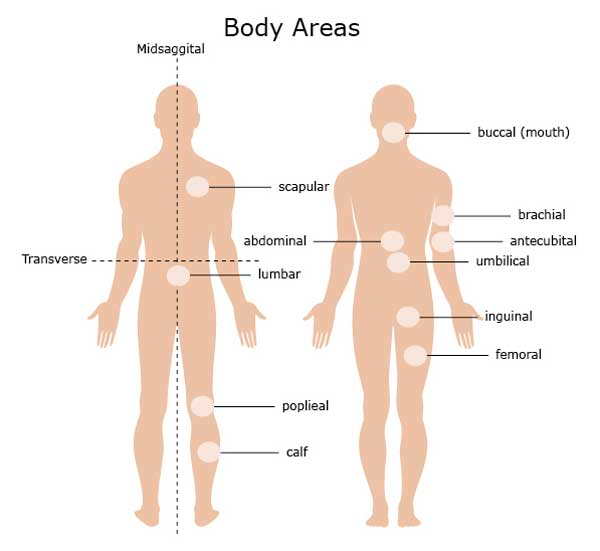
- Abdominal — relating to the belly.
- Antecubital — region of the arm in front of the elbow i.e. the skin pucker at the elbow.
- Brachial — over the brachial artery i.east. the upper arm
- Buccal — of or relating to the cheeks or the oral fissure
- Calf — relating to the calf
- Femoral — relating to the femur or thigh
- Inguinal — the groin or surface area in lower lateral regions of the abdomen
- Lumbar — area over the lumbar spine (low dorsum)
- Popliteal — region on the dorsum of the knee (i.e. over the skin crease there)
- Scapular — of or relating to the area near the shoulder blade (scapula)
- Umbilical — relating to the key area of the abdomen near the omphalus (the umbilicus)
Source: https://www.healthpages.org/anatomy-function/anatomy-terms/
0 Response to "what refers to a structure nearest to a major point of reference"
Post a Comment